
Transformational Communities
Transformational Communities are human communities which, through critically reflective practice, both experience and enable growth in capabilities oriented toward greater levels of responsible well-being.
A “community” is a group of people characterized by frequent and regular multi-person interactions (thus often but not always geographical proximity) and sharing a common identity, common interests, and a common destiny. It could thus take the form of a rural Cambodian village, an international non-governmental organization (NGO), a local church, or a bustling city in the metropolitan Los Angeles area.
We use the language of “reflective practice” to describe the iterative cycle of action and reflection which constitutes the core of experiential learning (see diagram for an expansion on this). By saying that this is “critically” reflective practice, we want to emphasize that this action-reflection dynamic has an eye to issues of social justice, by consistently examining assumptions related to power relationships and hegemony (Brookfield, 2004, pp. 342-343).
The purpose of this critically reflective practice is learning, or more specifically “growth in capabilities.” Here I am intentionally using the language of Sen (1999). Sen uses this language to refer to “the alternative combinations of functionings [which Sen defines as “the various things a person may value doing or being”] that are feasible for her to achieve” (p. 75). Simply put, a “capability” is the capacity to be or do something that the subject finds valuable. However, I like using this language because of the connection with Sen’s work and his definition of poverty as “capability deprivation.” This language thus allows us to situate adult learning in the context of international development discourse (see attached document for discussion of principles of effective development).
The ultimate goal in this learning process is the attainment of “responsible well-being.” I draw here on another development thinker in Chambers (1997). I appreciate Chambers’ description of “responsible well-being by and for all” (p. 11) as the objective for development. Chambers describes this responsible well-being as a web connecting responsible well-being with capabilities, livelihood security, equity, and sustainability (pp. 9-11). Other language that might be used is the term “human flourishing” (see attached document for a model of flourishing communities), or the Hebrew concept of “shalom.” What is important to me is that the idea of social justice is integrated into our understanding of well-being, and Chambers’ model seems to do that.
This is something that the local community both experiences and enables. In other words, the "transformational community" is not only one that experiences the flourishing of responsible well-being, but also becomes a channel of transformation which enables other communities to experience that same growth and development.
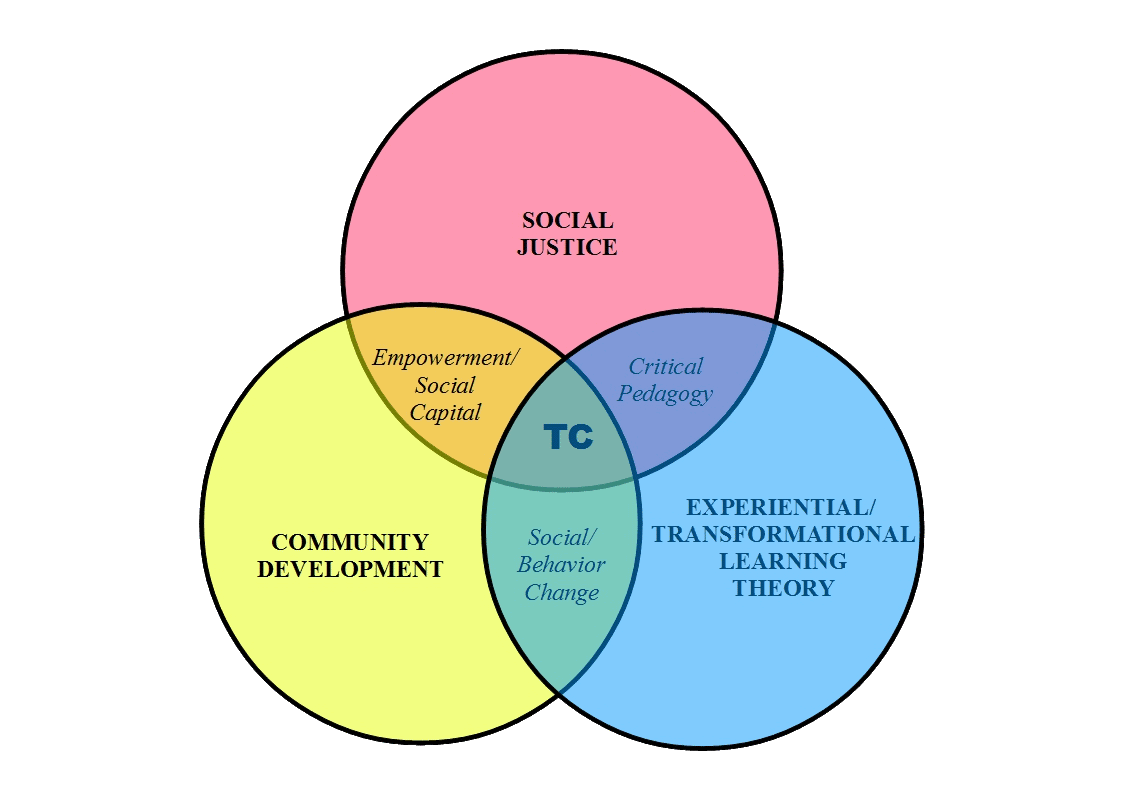
In the diagram provided, you can see how the "Transformational Community" (TC) is thus situated at the intersection of experiential/transformational learning theory, social justice, and community development. The diagram also suggests other intersections, which are additional themes worth exploring in relation to transformational communities. These additional themes include empowerment/social capital, social/behavior change, and critical pedagogy. Critical pedagogy is one area of particular emphasis within this portfolio.