
In Action

This section of the portfolio contains a summary of some historical, current, and potential applications of Education for Empowerment.
Educating the Educators
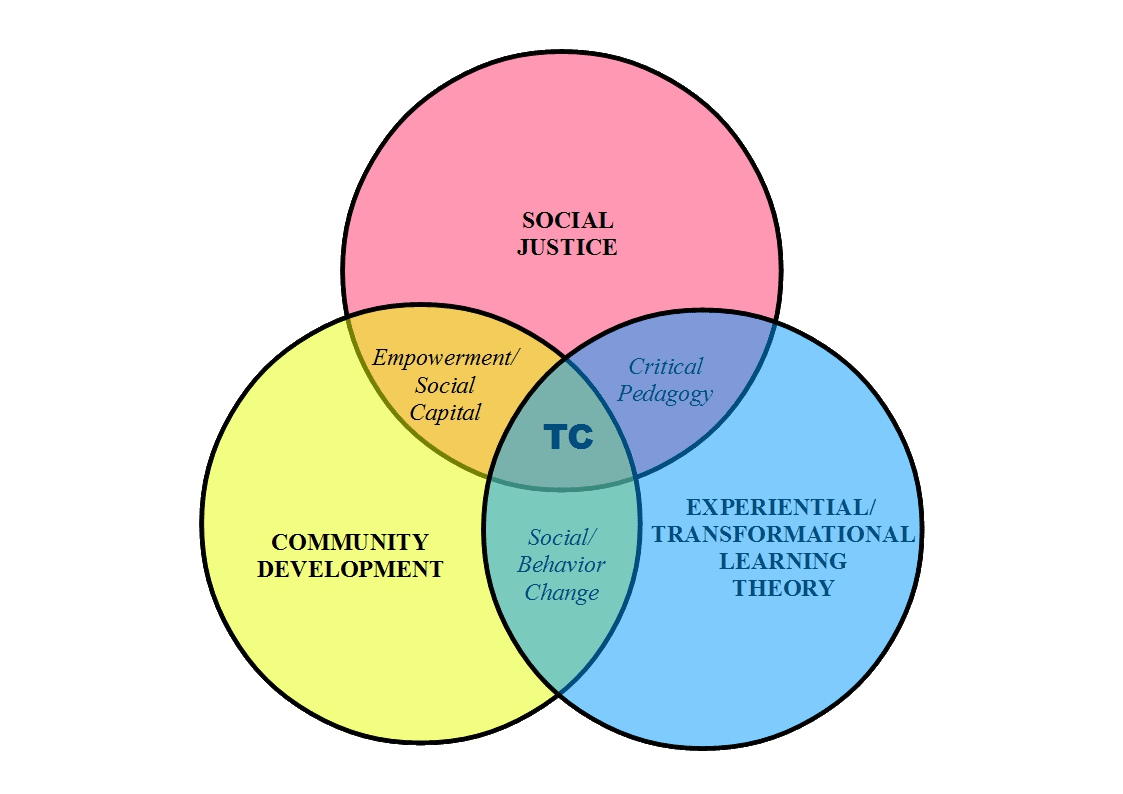
Jane Addams' work at Hull-House provides an excellent historical example of the mutual transformation that happens through education for empowerment. Addams' work also highlights the intersection between experiential education and social justice, and thus serves as a clear and compelling model of a transformational community.
New Life Program at Long Beach Rescue Mission
A more contemporary example of a profoundly relational and experiential approach to transformative adult education is evident in the New Life Program at Long Beach Rescue Mission. This paper provides an overview of that program.
Wat Than Artisans
Wat Than Artisans, according to their website, is “a worker-run cooperative of Cambodian artisans with disabilities, who are trained in handicraft production, including fine wood carving.” This brief ethnography, based on personal observation within their educational space, provides some insight into this program. This ethnographic study reinforces the reality of ability/disability as a dimension of privilege and vulnerability, one that must be factored into a movement toward comprehensive social justice.
White Privilege and the Evangelical Church
One approach to building a transformational community is to start with an existing faith community and apply principles of education for empowerment to it. This paper describes a proposed plan for an elective course in an evangelical Christian (predominantly white) church on the issue of racial privilege. The intent is thus to inject a stronger element of social justice into that community context in ways consistent with their faith tradition. The resulting "community of praxis" would thus be a strong step toward the vision of a transformational community.
Prepare Me a Table
In a similar vein to the above proposal for an elective on white privilege, "Prepare Me a Table" is designed as a course on food justice, again to be conducted as an elective within an evangelical Christian church. This course material was specificially designed with a high degree of attention to instructional elements which will contribute to learning transfer, the application of course-related learning outside the course itself. Thus, the material intentionally works to develop a community of praxis, pursues an approach of critical behavior change, and utilizes a "flipped" learning community structure. This portfolio includes a (partial) facilitator's guide and a commentary which explains the connection between various instructional elements and learning transfer theory.
FEAST Conference
Continuing the theme of "food justice," the materials below represent some preliminary program planning work I did in preparation for an intended conference on food justice. The FEAST Conference, on Food, Empowerment, and Sustainable Transformation, did not actually get conducted due to my departure from the leadership role of the hosting organization in Cambodia. However, the materials below outline the intentions for the conference, and are suggestive of another possible means of building a transformational community around this theme of just and sustainable food systems.